Melatonin and Sleep: How the Hormone Actually Works
Why Standard Melatonin Doesn’t Work for Everyone
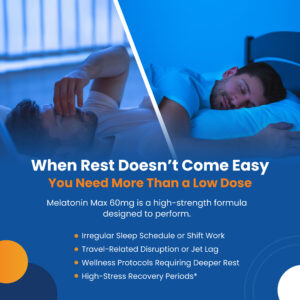
Standard OTC melatonin products contain doses in the 0.5mg–5mg range. These are designed for people with mild, occasional sleep disruption. For a significant portion of people, they simply don’t produce noticeable results. The reasons are varied — individual differences in melatonin metabolism, the degree of circadian disruption, age-related changes in natural production, and the cumulative effect of modern light exposure patterns all play a role.
None of this means melatonin doesn’t work for those people. It often means the dose isn’t right for their situation. That’s a conversation to have with a healthcare provider — not something we can advise on — but it is the reason high-dose melatonin exists as a category at all. Read more: Why Melatonin Stops Working: What Most People Get Wrong.
How Melatonin Actually Works
Melatonin is a hormone produced naturally by the pineal gland — a pea-sized structure in the brain — in response to darkness. As evening light fades, melatonin production increases and signals the body to begin its nighttime processes. Morning light suppresses it, signalling the start of the daytime cycle.
This is why melatonin is described as a circadian regulator rather than a sedative. It doesn’t put you to sleep the way a sleeping pill does — it signals the body that it’s time for nighttime to begin. The distinction matters: its effects are more like a sunset than a switch.
Modern life disrupts this system continuously. Screens emit blue light that suppresses melatonin production. LED lighting has the same effect. Working late, irregular schedules, and international travel all interfere with the body’s natural melatonin cycle. Supplemental melatonin is used to restore the signal the body is missing — or to provide a stronger signal when the natural one is insufficient.* See also: Melatonin for Jet Lag | Melatonin for Shift Workers.
What the Research Community Studies
Beyond its role in circadian regulation, melatonin has been studied for a broader range of properties. The research literature on melatonin is one of the largest bodies of work for any single molecule in nutritional science — thousands of published studies across multiple decades.
Researchers have explored melatonin’s antioxidant properties, its role in immune function, its relationship with cellular health, and its potential cytoprotective activity. These are areas of ongoing study. Read more: Melatonin as an Antioxidant: What the Research Explores.
We maintain an internal safety reference database compiled from peer-reviewed published literature. We entered this market because the science interested us — not because a trend did.*
Why Supplement Quality Matters
A 2017 study found that over 70% of melatonin supplements tested deviated significantly from their label claims. This is a systemic problem in the category. Read the full story: Melatonin Supplement Label Fraud: What the 2017 Study Found.
Our Product Range
We manufacture our melatonin at our Bella Phytologic facility in Santa Rosa, California under 21 CFR Part 111 cGMP compliance. Every batch is documented, tested, and quality-released. Clean formulations — melatonin, rice fiber, vegetable cellulose capsule. Nothing else. How We Manufacture Our Melatonin →
- Melatonin Max 60mg Capsules — Our flagship. Pre-measured, consistent.
- Melatonin Max 30mg — Mid-strength option.
- Melatonin Max 20mg — Strong entry point.
- Melatonin Max 10mg — Entry into the high-dose range.
- Melatonin Max 120mg — Our highest-dose capsule.
- Melatonin 60mg Gummies — Same dose, chewable format.
- Melatonin Pure 40g Bulk Powder — Flexible dosing. Requires a milligram scale. See: How to Measure Melatonin Powder | Powder vs Capsules Guide.
We do not offer dosage guidance. Your healthcare provider is the right person for that conversation. See our full guide: High Dose Melatonin Complete Guide | High Dose Melatonin Hub.
*These statements have not been evaluated by the Food and Drug Administration. This product is not intended to diagnose, treat, cure, or prevent any disease. This content is informational only and does not constitute medical advice. Consult your healthcare provider before starting any supplement.
]]>